Dental Implants
If your dentures slip while you talk, click when you chew, or rub sore spots into your gums, you already know how frustrating that daily worry can be. Many patients come to us tired of avoiding certain foods or holding back a laugh because they're not sure their denture will stay put. Implant-retained dentures in Brentwood, CA give you a secure, natural-feeling alternative that anchors to your jawbone instead of resting loosely on your gums. At Liberty Dental Group, new patients are always welcome, and we offer flexible financing through CareCredit and Cherry so a stable, confident smile fits your budget.
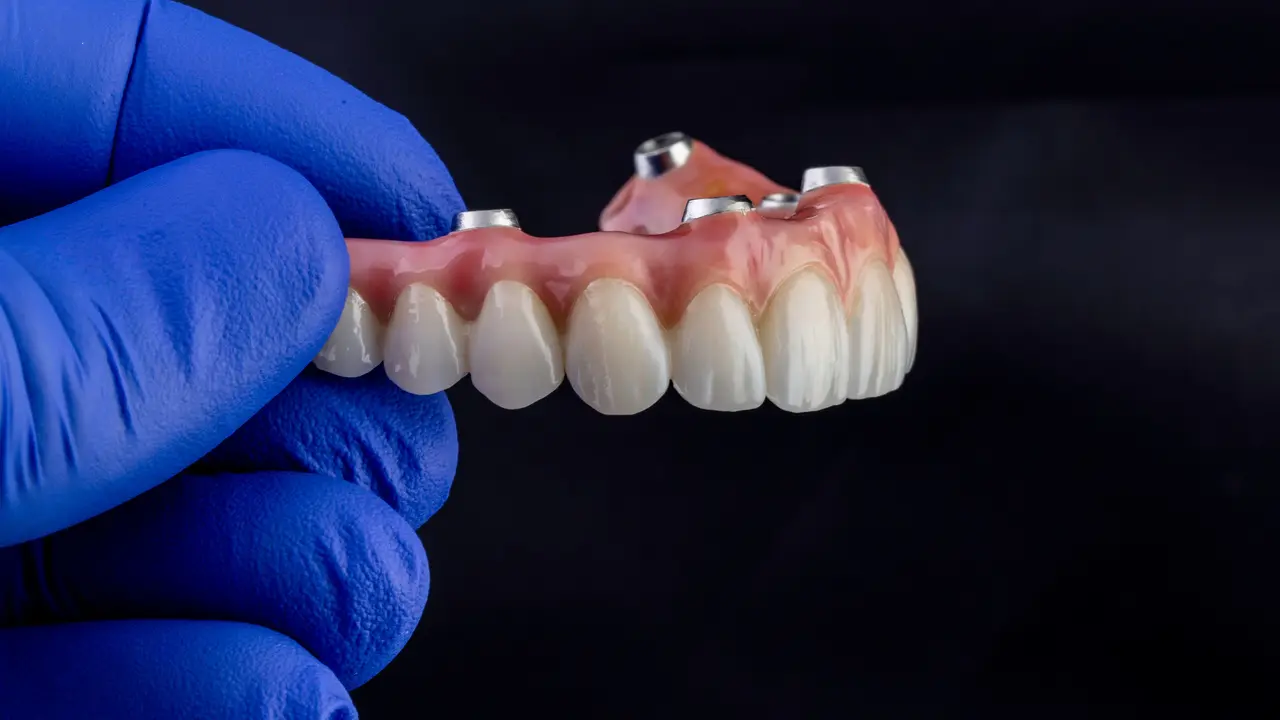
Implant-retained dentures use a small number of dental implants, titanium posts placed in your jawbone, to hold your denture firmly in place. Instead of relying on suction or adhesive, your denture snaps onto the implants, so it stays steady when you eat, speak, and smile.
Patients tell us the biggest difference is confidence. You can bite into an apple or eat corn on the cob without worrying about movement. Because the implants stimulate your jawbone the way natural tooth roots do, they also help preserve bone structure, which can support a fuller, more natural facial appearance over time. For many people, this option restores a level of comfort and function that traditional dentures alone can't offer, which fits our Total Health approach of caring for the whole person, not just individual teeth.
If you're missing a full arch of teeth, this approach works alongside options like All-on-Four full-arch implants, which use a similar implant foundation but attach a fixed, non-removable prosthesis instead.
Most adults with enough healthy jawbone and gum tissue are good candidates for implant-retained dentures. During your visit, Dr. Molosky reviews your dental and health history, takes digital images, and evaluates your bone density to see how many implants your denture will need.
Some patients have experienced bone loss after wearing traditional dentures for years or losing teeth some time ago. That doesn't necessarily rule you out. Bone grafting can rebuild the foundation needed to support implants in many cases. Gum disease, certain medical conditions, and smoking can affect candidacy too, which is why we talk through your full health picture before recommending a plan.
If you're only missing one tooth rather than a full arch, a single tooth implant may be a simpler, more targeted solution worth discussing instead.
We believe you should understand every step before you commit to it. That's the doctor-led education approach our patients mention again and again: real conversations, visual technology to show you your own scans and images, and clear answers before any decision.
The process usually starts with a consultation and digital imaging to map your jawbone and plan implant placement. If you need bone grafting, that happens first and requires healing time. Next, your implants are placed and given time to fuse with your jawbone, a process that can take a few months. Once healed, we attach the connective abutments and fit your custom denture so it snaps securely into place. Throughout, we check in on your comfort and make adjustments so the fit feels right for your mouth and your daily life.
Patients often ask how implant-retained dentures compare to traditional dentures and partials. Here's a side-by-side look to help you decide which fits your needs.
| Feature | Implant-Retained Dentures | Traditional Dentures & Partials |
|---|---|---|
| Stability | Snaps securely onto implants, minimal shifting | Rests on gums, can slip or click when eating or speaking |
| Bone preservation | Implants help stimulate and maintain jawbone | Bone loss may continue over time without implant support |
| Maintenance | Removable for cleaning, implants need regular checkups | Removable for cleaning, may need periodic relining or adjustment |
| Cost | Higher upfront investment due to implants | Lower upfront cost |
| Eligibility | Requires enough healthy jawbone, or bone grafting first | Broadly available to most patients regardless of bone volume |
There's no single right answer for everyone. Some patients value the lower upfront cost of traditional dentures, while others prioritize the stability and bone-preserving benefits of an implant-supported option. We're happy to walk through both during your visit.
There's no need to rush a decision, and we'll never pressure you into one. That said, it helps to understand what happens over time if you continue wearing loose or ill-fitting dentures. Jawbone tends to gradually reshape itself when it's no longer supported by tooth roots or implants, which can change how a denture fits and how your face looks over the years. Waiting doesn't close the door on implant-retained dentures, but it may mean bone grafting becomes part of your treatment plan later on. Whenever you're ready to explore your options, we're here to talk it through at your own pace.
Implant-retained dentures are one part of a broader set of dental implant solutions we offer, from single-tooth replacement to full-arch options, so you can find the approach that matches your specific needs.
Common questions
New to Liberty Dental Group or planning your next visit? Here are quick answers to the questions Brentwood families ask us most.
With good care, the implants themselves can last many years, often decades. The denture portion may need adjustment, relining, or replacement over time as it experiences normal daily wear.
Yes. Implant-retained dentures snap onto implants for a secure daily fit, but you or your dentist can remove them for cleaning. This is different from All-on-Four, which is designed to stay fixed in place rather than come out.
Cost depends on how many implants you need, whether bone grafting is required first, and the design of your denture. We go over your specific options and financing choices, including CareCredit and Cherry, during your consultation.
If loose, unpredictable dentures have kept you from smiling, laughing, or eating freely, let's talk about whether implant-retained dentures could change that for you.